Currently Empty: R0.00

How to Commission a Desalination System Before Operation
Desalination System Commissioning Guide
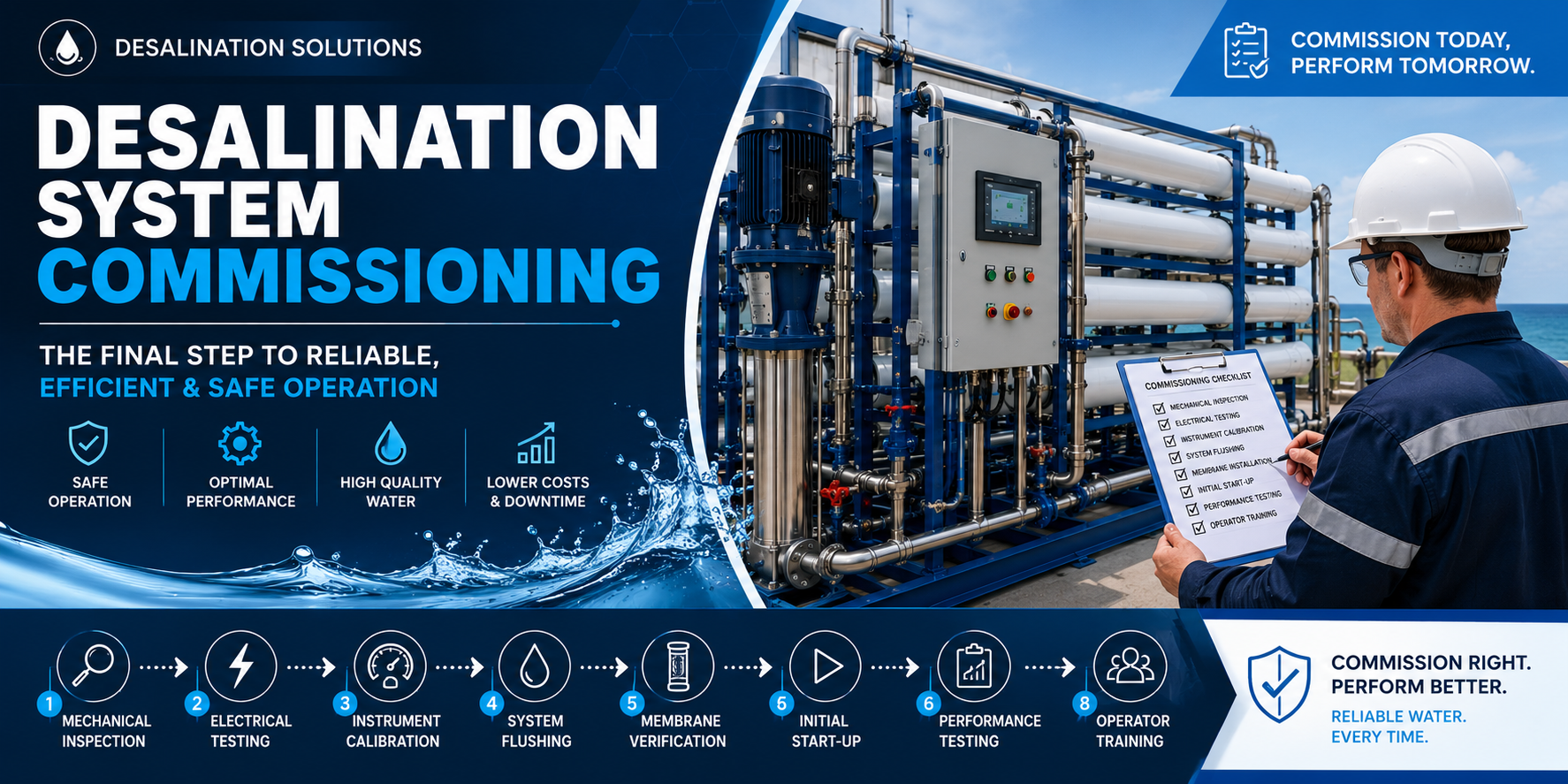
Desalination system commissioning is the final and one of the most important stages before a plant begins producing fresh water. During this process, engineers inspect, test and verify every component to ensure the system operates safely and efficiently. In addition, commissioning confirms that the plant meets its design specifications before full production starts.
Whether you install a desalination system for a municipality, mining operation, industrial facility or coastal development, proper commissioning reduces operational risks and helps deliver reliable long-term performance.
What Is Desalination System Commissioning?
Desalination system commissioning is the structured process of preparing a newly installed plant for operation. Rather than switching the system on immediately, engineers complete a series of inspections and performance tests.
During commissioning, they verify that:
- Equipment is installed correctly.
- Pumps operate as designed.
- Membranes are positioned correctly.
- Instruments provide accurate readings.
- Electrical systems function safely.
- Water quality meets the project requirements.
Only after completing every test should operators place the plant into continuous service.
Step 1: Complete a mechanical inspection
First, engineers inspect every mechanical component throughout the plant.
They examine:
- Pipework
- Pumps
- Pressure vessels
- Valves
- Membrane housings
- Storage tanks
- Structural supports
If they find loose fittings or installation errors, they correct them immediately before moving to the next stage.
Step 2: Test the Electrical System
Next, technicians verify that every electrical component functions safely and correctly.
They inspect:
- Power supplies
- Motor rotation
- Control panels
- Emergency stop systems
- Cable connections
- Earthing systems
- Alarm circuits
After completing these tests, they resolve any electrical faults before energising the plant.
Step 3: Calibrate the Instrumentation
Accurate measurements are essential for efficient operation. Therefore, technicians calibrate every monitoring instrument before startup.
These instruments include:
- Pressure transmitters
- Flow meters
- Conductivity meters
- Temperature sensors
- pH sensors
- Level switches
As a result, operators receive reliable operational data from the first day of production.
Step 4: Flush the System
Before installing or operating the membranes, technicians flush the pipework thoroughly.
This process removes:
- Dust
- Construction debris
- Metal particles
- Dirt
- Installation residue
Consequently, the flushing process protects sensitive equipment from unnecessary damage.
Step 5: Verify the Membrane Installation
Next, engineers inspect every membrane element carefully.
They confirm that each membrane:
- Sits correctly inside the pressure vessel.
- Has proper lubrication.
- Shows no visible damage.
- Fits securely.
Correct installation helps maximise performance and reduces the risk of premature membrane failure.
Step 6: Perform the Initial Startup
Once every inspection is complete, operators start the desalination system gradually.
Meanwhile, they monitor the following:
- Feed pressure
- Product water flow
- Recovery rate
- Salt rejection
- Conductivity
- Pump vibration
If necessary, they adjust the operating conditions until the plant reaches stable performance.
Step 7: Carry Out Performance Testing
Finally, engineers compare the plant’s actual performance with the original design specifications.
They evaluate:
- Freshwater production
- Salt rejection
- Energy consumption
- Recovery rate
- Operating pressure
- Product water quality
Only after the system achieves every required target do engineers approve the plant for full operation.
Common Commissioning Challenges
Although commissioning follows a structured process, several challenges may appear.
Common examples include:
- Air trapped inside pipelines
- Incorrect valve settings
- Calibration errors
- Pump cavitation
- Membrane leaks
- Pressure fluctuations
Fortunately, engineers can identify and correct these issues before the system enters normal operation.
Why Commissioning Matters
A thorough commissioning process provides several long-term advantages.
For example, it helps operators achieve the following:
- Reliable performance
- Lower maintenance costs
- Longer membrane life
- Better water quality
- Improved energy efficiency
- Reduced equipment failures
Furthermore, proper commissioning gives operators confidence that the plant will perform as intended from the first day.
Frequently Asked Questions
How long does commissioning take?
The duration depends on the size and complexity of the desalination plant. Small installations may take only a few days, whereas large municipal facilities often require several weeks.
Who performs commissioning?
Experienced engineers, equipment suppliers, and commissioning specialists usually work together to complete the process successfully.
Can a desalination plant operate before commissioning?
No. Engineers must complete commissioning before operators place the plant into continuous service. Otherwise, undetected problems could reduce performance or damage equipment.
Does commissioning include operator training?
Yes. In most cases, suppliers train plant operators during commissioning. As a result, operators learn the correct startup procedures, maintenance requirements and emergency responses.
Conclusion
Desalination system commissioning ensures that every component performs safely, efficiently and according to the original design. By following a structured commissioning process, engineers reduce operational risks, improve system reliability and maximise long-term performance. Ultimately, investing time in proper commissioning protects valuable equipment, reduces future maintenance costs and helps deliver a dependable supply of fresh water for years to come.